





Sports · August 30, 2026
Seattle U's Championship Field: Sightlines, Light, and Kickoff Times
Championship Field runs north to south, and that decides almost everything: which sideline I pick, when flare eats a stretch of the second half, and why morning and under-the-lights kickoffs come home with the most usable frames.

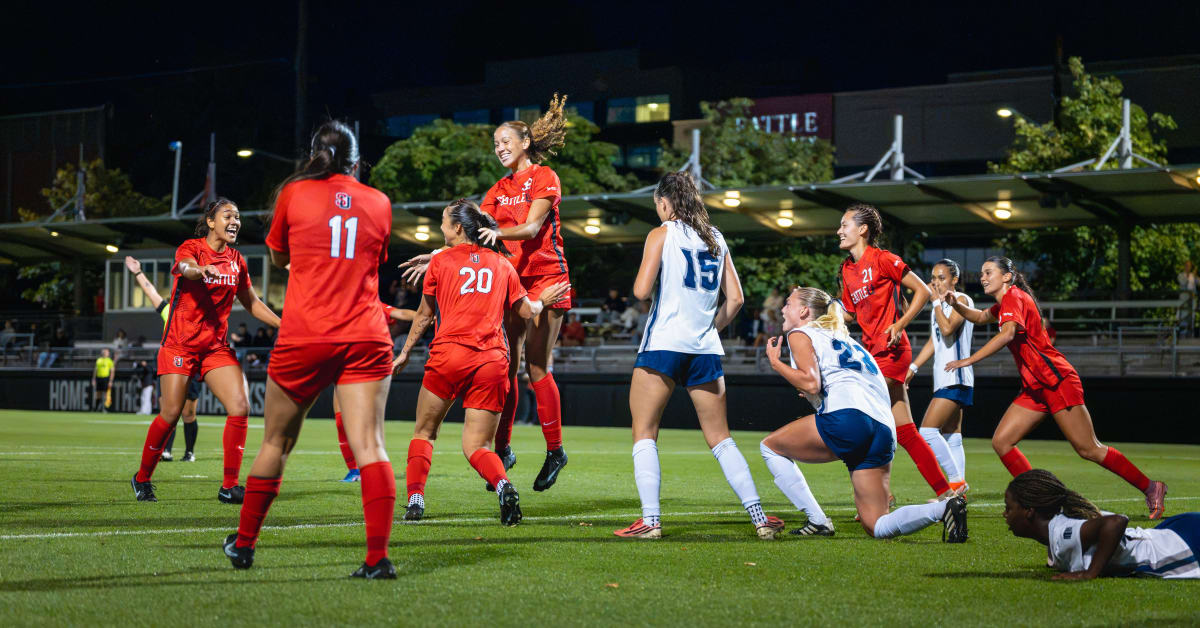


I've been shooting Seattle University Women's Soccer games for a while now — my sister Zoe plays for them, which is honestly the whole reason this team is in my portfolio at all. I'm not covering them as some random assignment. I'm on that sideline because my sister is out there, and over time that's turned into actual, paid sports photography work. Soccer's still the only sport I shoot, and this field is the one I know better than any other patch of grass in the state.
That said, I want to be straight with you about what I'm covering here. This post is about how I actually work this specific venue — sightlines, where the light does what, when to show up — grounded in what I know from shooting there, not a generic "how to shoot soccer" list.
Where I set up
Championship Field has sideline access that's pretty workable compared to some of the club fields I've shot at. I've got access to three of the four sides of the field — both sidelines and one end line — the only place that's off-limits is wherever the team bench is set up, which makes sense. That's more room to work with than most club venues give you.
My default spot is even with the top of the penalty box, low to the ground, because that's where I get the ball-to-goal angle without shooting straight down the touchline. If Zoe's team is attacking away from me, I'll walk it down toward the corner flag rather than try to shoot the play from behind — a soccer photo taken from directly behind the run just reads as a bunch of backs. You want faces, or at least a three-quarter angle on the body, and that means committing to a side before the run develops, not chasing it mid-play.
For portraits or reserved shots after the game, this field makes it easy. Once the final whistle blows, I'm free to walk on and shoot — no waiting around for permission, no coordinating in advance. That's not something I take for granted; it's one of the more relaxed post-game access situations I've worked with.
Light through the day
Afternoon games are the tricky ones here. Championship Field runs north-south, which means the sun's afternoon arc sits off to one side of the pitch rather than straight down the middle — exactly which side depends on kickoff time, but by mid-to-late afternoon it's low enough to catch me square in the lens for a stretch of the second half no matter which sideline I've picked. I carry a lens hood for exactly this reason and I've learned to just accept that some games I'm going to get flare shots I can't use, and plan my angle around minimizing it rather than eliminating it.
Evening games under the lights are a different animal entirely. The Sony A7IV handles high ISO better than anything I shot before it, so I'm not scared of pushing to 3200 or higher under stadium lighting the way I would've been on my old Nikon. That's the setup that made this feel like real, professional work rather than me just standing on the sideline with a long lens — once I had a camera body that could actually keep up with fast action in bad light, shooting games stopped being a guessing game and started being a job I could do consistently.
Morning games, when they happen, are the gift. Soft, even light, no flare problems, no fighting shadows across half the pitch. If I know a game's got an early kickoff I'm there earlier than I need to be, because that light doesn't last and I want frames from warmups too, not just the whistle.
Getting there and getting set up
Parking near the field is street parking — nothing dedicated — so I budget a few extra minutes hunting for a spot, especially on weekends when other games or campus activity are pulling from the same few blocks. I try to get there with enough time to walk the sideline once before players start warming up, just to check where the sun's sitting that day and whether there's anything new blocking a normal angle — a maintenance cart, a new fence section, whatever. Fields change a little season to season and I don't like assuming last year's setup still holds.
Gear-wise for this field specifically, I'm running the Sony A7IV with a 70-200mm. A long lens matters more here than it does at some of the smaller club fields, just because of how far back the sideline access sits from midfield in a couple of spots.
What I actually walk away with
The frames I care about most from this field aren't the wide shots of the whole pitch — those are fine for context but they don't say much. It's the moment right before a shot goes off, the ball still on the foot, or a defender's face right as she reads the play. That's the stuff Zoe's teammates actually want, and it's the stuff that's translated into other work too — Sophie H.'s NIL shoot for her adidas deal came out of understanding how to catch an athlete mid-motion rather than posed, and that instinct started on this sideline, watching this team play, more Saturdays than I can count.
If you're a player or a parent trying to figure out when to grab a photographer for a game at this field, my honest advice is: check the kickoff time against the field's sun direction before you lock in a date, if you have any say in it. Morning and evening-under-lights are the two conditions where I come home with the most usable frames. Midday summer games are the ones where even a good camera is fighting the sun the whole time.